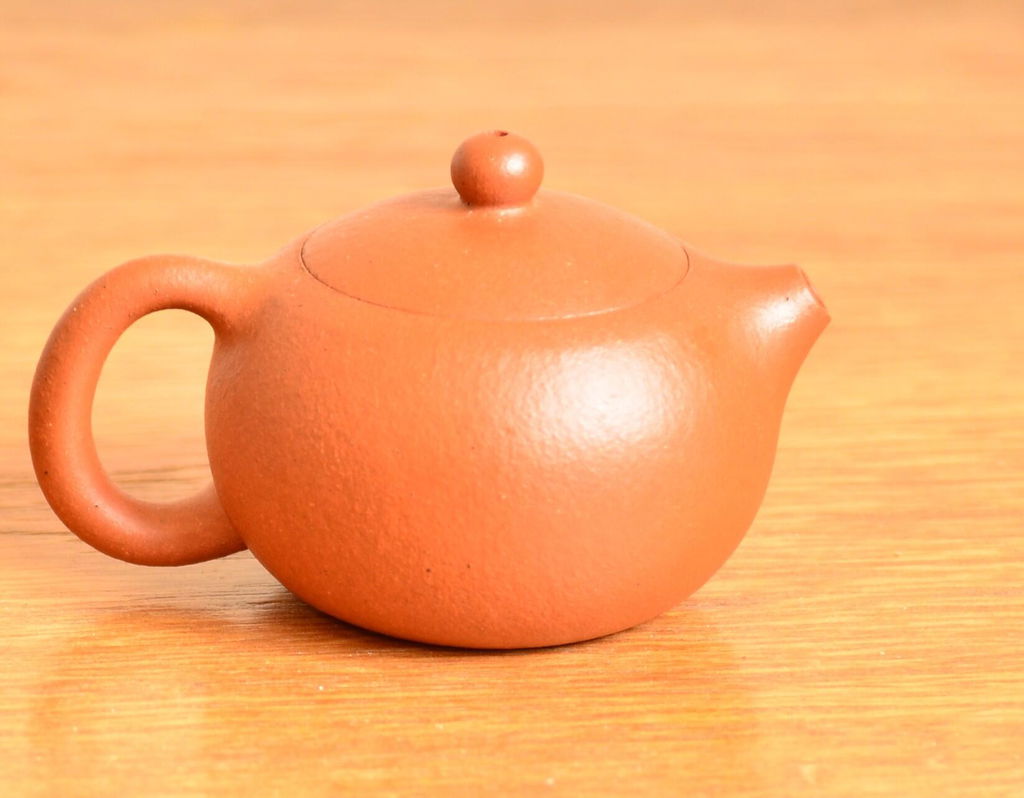
Da Bin Ru Yi《大彬如意》, 178.1ml, *Tai Xi Ye Shan Hong Zong Zi Ni 台西野山红棕紫泥!, by Craftsman Zhang Huan 张欢 ~!Congratulations to Dr C.S.! 0931hrs 14th Apr 2026, Sherman Oaks! CA!
https://www.realzisha.com/pages/fully-handmade-zisha-art-and-craft-and-tea-pairings
《大彬如意》Da Bin Ru Yi!
This Da Bin Ru Yi model of ~180ml will be featured in different clays along our journey! You may collect one of each for a beautiful collection!
Dearest Friends, here we grandly welcome you to another of our Cao Family's clay: * The Tai Xi Ye Shan Hong Zong Zi Ni 台西野山红棕紫泥 *
Huang Long Shan has several quarries, notable amongst them e.g. 4th Quarry, Tai Xi quarry, Da Shui Tan, Bao Shan.
Next to the Tai Xi quarry, there is another second quarry just adjacent, which we affectionately call Tai Xi Ye Shan "Wild Mountain" kuang 台西野山矿!!!
In Li Hong Yuan and Zhu Ze Wei's books on ZiSha, this documented ore/clay type is recorded down very clearly and succinctly too:
"矿: 含有一定量的白色云母碎片.
烧成后呈紫棕红色调, 胎质颗粒质感较好, 但外观色泽纯度略差。"
MEANING:
The Ore: significant presence of WHITE MICA pieces! After firing, it presents in purplish~brown~red colour tones, the sandiness/graininess is very good, and the appearance highly heterogeneous.

Let us explain this long name, in three clear parts!
1. "Tai Xi Ye Shan 台西野山" ~ 野山 translated means "Wild Mountain"
Here in YiXing, we affectionately assign the term "Wild Mountain" :-D to this Tai Xi mine pit, although it is not "wild", and still part of Tai Xi Quarry Area, just that it is not the first and main mine pit.
This very second Tai Xi adjacent mine exists this enigmatic clay!!
2. "Hong Zong ": meaning Reddish-Brown!
3. "Zi Ni ": meaning Purple Clay!
It is an enigmatic clay: it IS CLASSIFIED as a Zi 紫 Ni (紫 Purple Clay) type, and yet its final appearance post-firing, is reddish-brown and is extremely sandy with white mica pieces!
This Tai Xi Ye Shan 台西野山Hong Zong 红棕 Zi Ni 紫泥 ORE, PRESENTS ITSELF IN THE SAME *PURPLE COLOUR TONE* in the RAW ORE STATE, just like OTHER Zi NI (that is why it is classified as Zi Ni, and NOT Duan Ni).
YET, it fires to reddish-brown, is extremely sandy, and contains a lot of white mica.
It is extremely crumbly in the forming up stage on the crafting bench.
This second Tai Xi adjacent mine, the Tai Xi Ye Shan mine, contains this very special clay Tai Xi Ye Shan Hong Zong Zi Ni which our grand father had mined and kept for us Cao Family descendants! AND WE ARE NOW VERY PROUD TO PRESENT TO ALL OF YOU TO KEEP AND, MAKE TEA!!!
Here in one of the best Classic Shapes by legendary Shi Da Bin:《大彬如意》Da Bin Ru Yi!
As we mention before, Da Bin Ru Yi will be crafted by Zhang Huan in various clays! Remember to collect one of each along the way, to make for a stunning spectrum of same model, different clay especial collection! Da Bin Ru Yi is instantly recognisable by its supremely Oriental aura, delightful feet, a stance that is both graceful and stately.
Always a strong jet pour, decisive cuts, excellent, elegant Oriental poise.
Enjoy your Da Bin Ru Yi, this time in our Cao Family's enigmatic Tai Xi Ye Shan Hong Zong Zi Ni!!

Zhang Huan aces all aspects of this Da Bin Ru Yi, and we entrusted him with this model. He had previously crafted it in Di Cao Qing, and here, in our Cao Family's Shui Tan Ben Shan Duan to enliven your Da Bin Ru Yi collection which will be scheduled to be made in various clays!
The spout, a delightful Swan neck, confident, a quick kink upwards, and then confidently rising upwards and forwards with a handsome forward end! All tastefully crafted by Zhang Huan:

The lid knob is surrounded by, yes the quintessential Auspicious sign for us Chinese: the Ru Yi Wen 如意纹。


Zhang Huan bends the handle to perfection, and BLENDS it in to join the body with extreme finesse:
- bottom part, with an ever so slightly flaring outwards, to meet the body,
- top part, with the carefully sculpted motif, all neat and smart.


One of the most difficult part, is here, around the base, where Zhang Huan needs to pat and blend both the side wall slab, to meld naturally with a CONTINUOUS smooth, rounded silhouette, with the concaved base slab.


Your new tea drinking friends will immediately take note of Shi Da Bin's ingenuity: the baby's feet, all so distinct and rcognisable. Great relief Art as one picks up the pot and tilts it sideways. Never an easy work to craft each foot to perfection (as close as possible), site each on the base, and do the refining work on the surface to make each of these organically curved feet looking smooth and detailed.
Amazing work by Zhang Huan again!


~~~~~~~~~
Shui Tan Ben Shan Duan is a type of Duan Ni, excellent for Sheng Pu Er 生普洱 and Shu Pu Er 熟普洱。
We hope dearest friends in you, will love it and use them in your daily tea session!
Craftsman Zhang Huan 张欢, since young, has embarked on his journey of crafting Austere ZiSha works of HIGH QUALITY. He had been noticed and hand-picked by Senior Cao Lan Fang and Senior Master Lu Xue Feng over observation of the past decade, and they have taken him in as their very hardworking disciple and CORE COLLEAGUE.


After three years of perfecting further his already polished skills, his works have consistently been given more than a nod by our Artists, be it Senior Master Lu Xue Feng, Senior Master Cao Lan Fang, Assoc Master Yang Quan Sheng, Assoc Master Li Yan Ru, Assoc Master Du Cheng Yao. Craftsman Zhang is NOW proudly one of us and he will be featuring consistently, and he also works closely with Yi Xiao Ran (featured in our home page video) and also Chen Fa Chu (together both being the longest serving Craftsmen with us). Craftsman Zhang Huan is naturally gifted, and extremely dedicated to perfecting his Art. His works have been noticed and appraised highly. The lines and detailing of his pots are unmatched for their prices. His lines and detailing speak of his EXTREME CARE AND TIME taken to craft each part, each pot. The lines and detailing speak of his fighting through his years from very challenging family conditions since young.
Only a very well-trained, experienced and skilful Craftsman will be able to understand the curves and proportions perfectly, and here beautifully captured and crafted by Craftsman Zhang Huan.
Craftsman Zhao's works are highly scrutinised by our Senior Masters, and deemed to be ready for you, delectable for your use and a long lasting permanent ZiSha work in your collection.
~~~~~~~~~~
Again, another tremendous labor of love by our trusted and committed collaborative Craftsman Zhang Huan. It is a team effort and we thank you dearest Friends for your grandest support to the honest and the dedicated Craftsladies and Craftsmen here left to fend the Fully-Handmade ZiSha Art.
Hold one, hold up one, swing his work around. Carefully examine his Fully-Handmade work. Look at it from afar, from near, and it will grow on you. The whole piece grow on you because 1) he takes reference from what the Senior Masters chose for him, 2) and he amazingly crafts them up EXACTLY as to what the Senior Masters want from him: extreme fine detailing with MUCH THOUGHT on each part, with MUCH TIME spent on every part, section. Because this is what Fully-Handmade ZiSha Art should be, and HOW FULLY-HANDMADE ZISHA ART is so different from and light years ahead of the ubiquitous jigger-machined pots and half-handmade pots masquerading under the sales tagline of "fully-handmade zisha" pots. These latter JM/HHM pots are made in what we call 流水线 a.k.a. 'Factory-Line operation' whereby the main pot body after being jigger-machined or coming off from the mould, is passed to the next worker who fits on the spout, and subsequently this second worker will pass the pot on to another worker who will in turn fit on the handle. Continuing so, the pressed lid is likewise passed to another worker who fit on the lid knob. EACH WORKER has NO IDEA what the other one is doing, and they are always working on fixed time lines stated by the boss. For example, the worker being "passed the baton" a pot with the spout just fixed onto the body by his colleague, will only focus on fixing on the handle, with nil to little regard to WHETHER THE HANDLE fixed on will be cohesive with the spout. Each worker has NO idea of HOW THE FINAL POT WILL LOOK LIKE. Beyond poor craftsmanship and clay, the result of such processes are ugly pots with poor cohesiveness which experienced Artists, Craftsmen and collectors will tell from a metre away. Experienced people in us, do not need to pick up a pot to check whether it is fully-handmade or made of zisha, we can tell from a metre away just by looking at the pot.
~~~~~~~~~~~~
The keywords are: Detailing and Cohesiveness.
A GOOD Fully-Handmade ZiSha Work combines great detailing and cohesiveness.
~~~
Explained, https://www.realzisha.com/blogs/news/actual-zisha-landscape-at-yixing , the Craftsman by selling his hard-worked ZiSha craft at $190-$240, $45-$65 goes to the cost of the craft, inclusive of the fees for the firing for the kiln operator (three times per pot), the packaging boxes, and between $32 to $52 for the clay (Zi Ni Di Cao Qing, Duan Ni and upwards) used per pot. Craftsman takes 3 days (fastest 2.5days) to craft a pot.
If he works 30 days a month without a single day of rest (no family time), he will craft 10-12 pots.
If he crafts for 25 days (five days of rest a month), his output will be 8-10 pots.
The success rate for Zi Ni (e.g. Di Cao Qing, Lao Zi Ni, Da Shui Tan etc) and Duan Ni (e.g. Jiang Po Ni, Qing Hui Duan, etc) is 70% on average. Some times the whole batch of 10 may fail. We have seen our Craftsmen suffer like this very often.
The success rate for Zhu Ni (e.g. Xiao Mei Yao Zhu Ni) pots is 60%, or 70% with most optimism and at the very, very best. Unfortunately.
All of us at RealZiSha of course, hope for one another, professional colleagues and all, that all the pots will survive firing at the kiln successfully.
[For ZiSha models/designs that are very challenging and more complicated to craft, the time taken to craft will be longer, and the failure rate will be higher as well. Zi Sha by its virtue, have the highest shrinkage rate of all ceramic clay. Zi Ni and Duan Ni thus have that 70% success rate, while Zhu Ni has even higher shrinkage rate and thus even lower success rate (the lowest of all ceramic clay.)]
Our Craftsmen are wholeheartedly committed to the cause of Fully-Handmade ZiSha Art and their strictness with their craft and dedication earn our respect. We give a big Thank You all of these Craftsmen, for they are saving what is our common precious tea culture: Tea + Fully-Handmade ZiSha Art and Craft. Your support is critical to their livelihood and the existence of this craft for all of the tea fraternity.
Thank you Friends!
~~~~~~~~~~~~~~~~~~~~~~
Our Senior Masters have given Craftsman Zhang Huan the full blessings with all of us. He is fully-fledged at RealZiSha. Most important, after all the hard work,
We are very happy that he is now with all of you.
Presenting Zhang Huan and his hard-worked and fine-worked Pieces for you. One by one.
~~~~~~~~~~~~