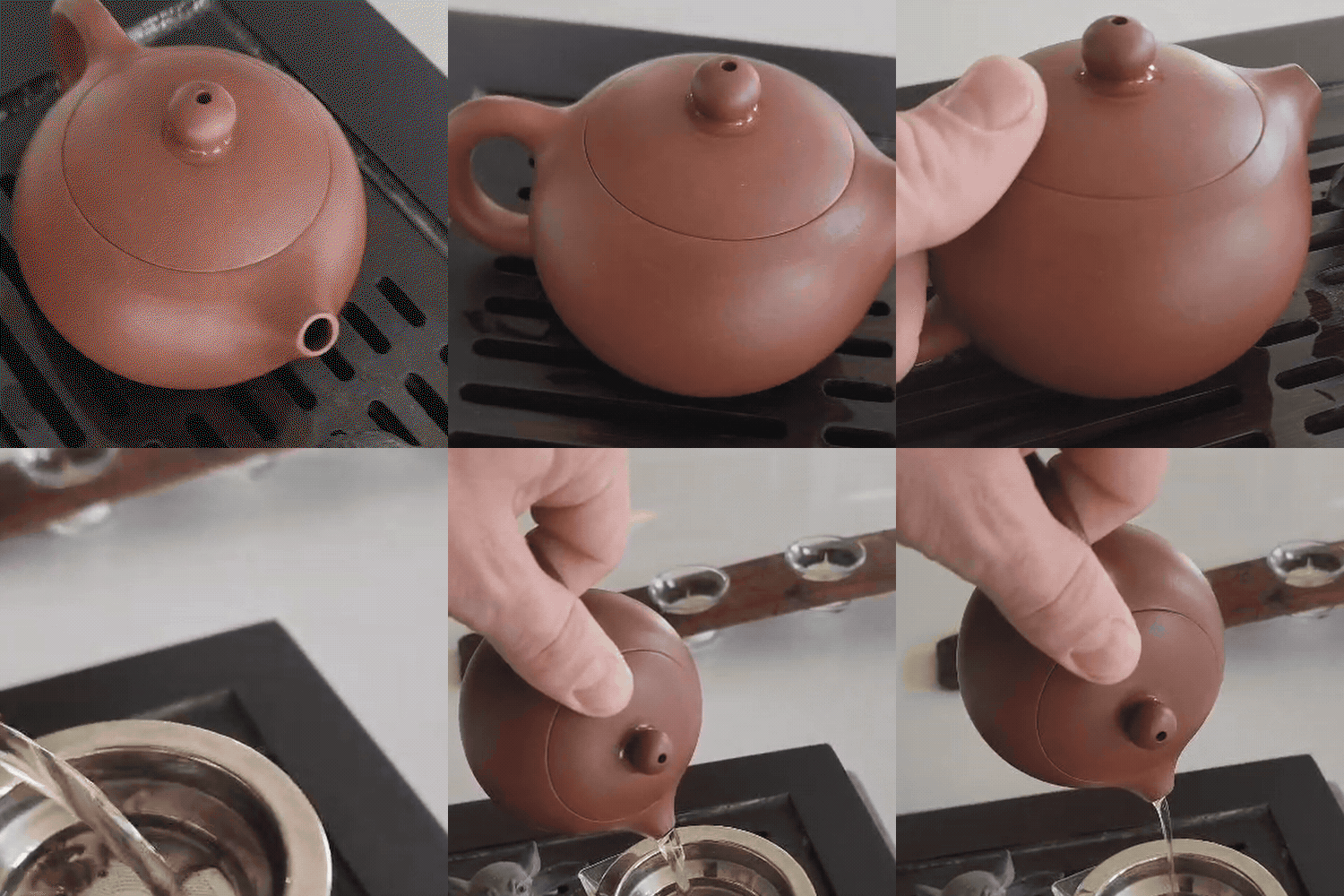
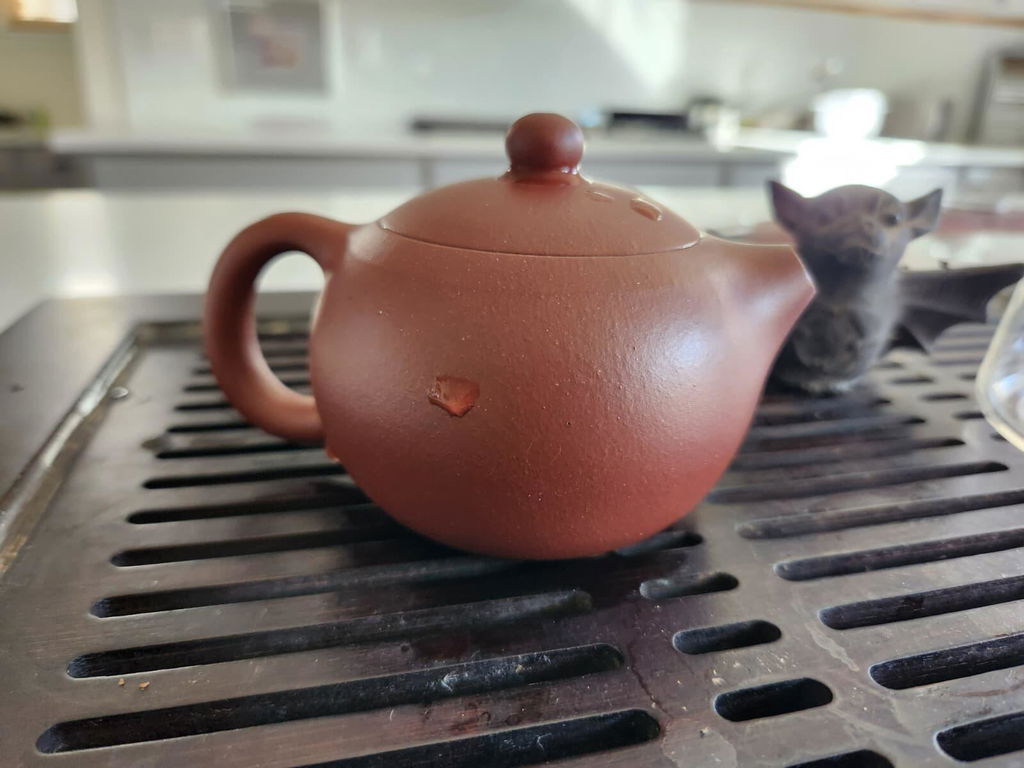
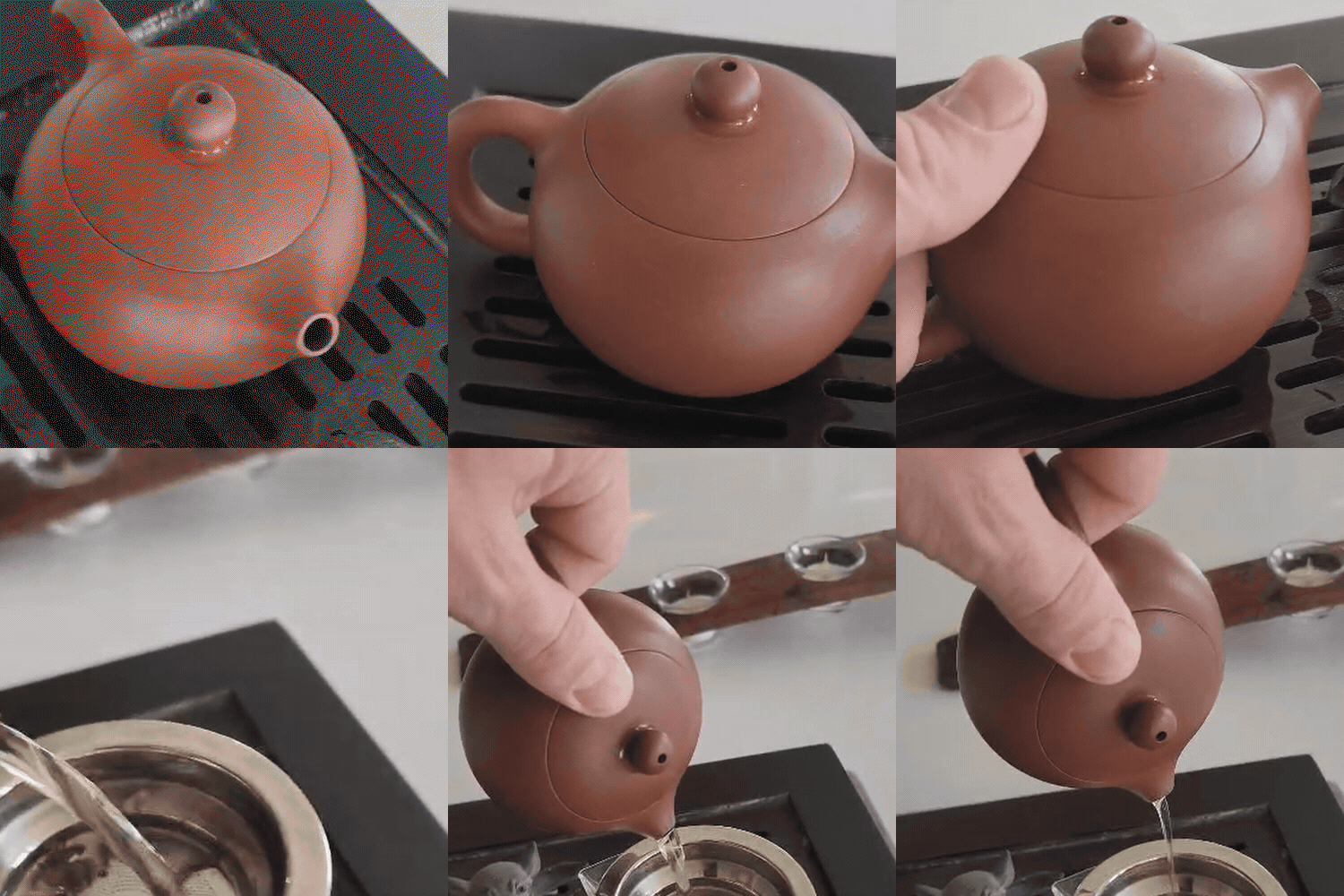
《孟臣三足》"Meng Chen San Zu", 210.2ml, Xiao Hong Ni, by Craftsman Zhang Huan 张欢, Bamboos & Calligraphy engraving by Craftsman Mu Shan 牧山!~ CONGRATULATIONS!!!TO MR R.K.! 2151hrs 8th October 2026, Bali! Indonesia🇮🇩!
https://www.realzisha.com/pages/fully-handmade-zisha-art-and-craft-and-tea-pairings
“竹摇清影罩幽窗 (两两时禽噪夕阳)”
From Zhu Shuzhen's "Early Summer" (Song Dynasty)
Bamboo casts its elegant shadows on the quiet window in the gentle breeze, while pairs of birds chirp and sing noisily in the setting sun.
This line combines stillness and movement.
The static imagery of "clear shadows" and "quiet window" contrasts with the dynamic imagery of "swaying bamboo" and "chirping birds," vividly depicting the scene at the end of spring and the beginning of summer.
《孟臣三足》"Meng Chen San Zu"!

This is a very beautiful and historical antique design that hails from the 18th Century, Qing Era:
Zhang Huan and Mu Shan worked together this time to accomplish this beautiful Meng Chen San Zu, and relish our Cao Family's Xiao Hong Ni 小红泥!
Xiao Hong Ni 小红泥! Xiao Hong Ni, sits besides Da Hong Ni, and both of them helm their position under one of the two major umbrellas of Hong Ni.
Hong Ni comprises the "ZISHA HONGNI" umbrella and the "ZHUNI" umbrella.
Xiao Hong Ni and Da Hong Ni (Yuan Kuang Da Hong Pao) are the two types that make up ZiSha Hong Ni!
Xiao Hong Ni 小红泥 and Da Hong Ni 大红泥 (Yuan Kuang Da Hong Pao 原矿大红袍) are the two types that make up ZiSha Hong Ni!
Xiao Hong Ni 小红泥:
These Xiao Hong Ni ores are passed down through the generations in our Cao Family, and now Senior Master Cao entrusted a limited stock to Craftsman Zhang Huan to be crafted into this Da Bin Ru Yi.
Xiao Hong Ni brews excellently: Aged Sheng Pu Er, and Shu Pu Er! Generally, we favour Zhu Sha 朱砂, Xiao Hong Ni 小红泥, Da Hong Ni 大红泥(Yuan Kuang Da Hong Pao 原矿大红袍) and Hong Jiang Po Ni 红降坡泥 for this application.
IT brews excellently Aged Sheng Pu Er, and Shu Pu Er!!! Some of our Chinese tea masters swear by it for this application.
Generally, we favour Zhu Sha 朱砂, Xiao Hong Ni 小红泥, Da Hong Ni 大红泥(Yuan Kuang Da Hong Pao 原矿大红袍) and Hong Jiang Po Ni 红降坡泥 for this application.


The Swan neck spout, is beautifully mastered and executed by Zhang Huan.
Craftsman Mu Shan 牧山 pampers us again with his delightful Kai Shu Calligraphy and Bamboos Engraving!
Assuming the user is right-handed,
Kai Shu Calligraphy Engraving faces the Tea Master,
“竹摇清影罩幽窗 (两两时禽噪夕阳)”
From Zhu Shuzhen's "Early Summer" (Song Dynasty)
Bamboo casts its elegant shadows on the quiet window in the gentle breeze, while pairs of birds chirp and sing noisily in the setting sun.
Notes:
* **罩幽窗 (zhào yōu chuāng):** The bamboo shadows darken the window.
*两两 (liǎng liǎng):** Pairs of birds.
*时禽 (shí qín):** Seasonal birds.
*噪 (zào):** Noisy, disruptive.
Analysis:
This line combines stillness and movement.
The static imagery of "clear shadows" and "quiet window" contrasts with the dynamic imagery of "swaying bamboo" and "chirping birds," vividly depicting the scene at the end of spring and the beginning of summer.


Bamboos engraving faces the Guests,


Zhang Huan and Mu Shan both sincerely hope you friends enjoy this highly Oriental and historical model!
They thank all of you for your love! They will continue working hard as much as possible at all months of the year. Welcoming all of you to YiXing too so that we can drink together!
Shrinkage of Fully-Handmade ZiSha,


After three years of perfecting further his already polished skills, his works have consistently been given more than a nod by our Artists, be it Senior Master Lu Xue Feng, Senior Master Cao Lan Fang, Assoc Master Yang Quan Sheng, Assoc Master Li Yan Ru, Assoc Master Du Cheng Yao. Craftsman Zhang is NOW proudly one of us and he will be featuring consistently, and he also works closely with Yi Xiao Ran (featured in our home page video) and also Chen Fa Chu (together both being the longest serving Craftsmen with us). Craftsman Zhang Huan is naturally gifted, and extremely dedicated to perfecting his Art. His works have been noticed and appraised highly. The lines and detailing of his pots are unmatched for their prices. His lines and detailing speak of his EXTREME CARE AND TIME taken to craft each part, each pot. The lines and detailing speak of his fighting through his years from very challenging family conditions since young.
Only a very well-trained, experienced and skilful Craftsman will be able to understand the curves and proportions perfectly, and here beautifully captured and crafted by Craftsman Zhang Huan.
Craftsman Zhang's works are highly scrutinised by our Senior Masters, and deemed to be ready for you, delectable for your use and a long lasting permanent ZiSha work in your collection.
We hope to bring all of you more and more classics, for you to hold a broad view and savour the delightful landscape of ZiSha works that our YiXing fraternity has!!!
A treasure chest and our team will continue to work very hard to prepare and bring forth every single piece to you. Thank you, dearest Friends for your understanding.
~~~~~~~~~~
Also to be cherished and witnessed in this ZiSha Work, you : besides the usual important, critical and beautiful hallmarks of a Fully-Handmade ZiSha pot, this pot has the discontinuous and roughly horizontal marks evident on the inner walls, and these are called the: 泥凳纹 Ni Deng Wen, which are the marks left on the clay slab, complementary to the marks on the workbench of the Craftsman Zhang Huan; During the making of FHM ZiSha pots, the Craftsmen will be using tools to cut the clay slabs, etc, and these cutting strokes will leave marks on the studio workbench. Especially the first major forceful cut across the table to delineate the clay she/he wants to utilize to form the main body of the body. Thus when the craftsman subsequently pound the clay slab on the workbench, these marks will be etched onto the clay slab. Thus you are "enjoying" the additional natural hallmarks of a Fully-Handmade pot. Even a partially handmade pot will not show these marks. And those fake, those Jigger-machined pots may show CONCENTRIC continuous circular lines, usually all parallel to one another, and extremely uniform.
Take note that these Ni Deng Wen lines are CONVEX AND PROTRUDING OUTWARDS from the flat clay slab wall, not marked inwards. They protrude *out* due to them being complementary to the worn and cut *in* lines on the wooden bench the Craftsman is working on. Therefore, do cherish and have fun admiring the discontinuous, roughly horizontal lines on your pot's inner walls, are called, the 泥凳纹 Ni Deng Wen "Workbench Lines/Marks".
~~~~~~~~~~~~
BRING ONE HOME, USE IT and you will know all about Fully-Handmade ZiSha, the feel of real and quality YiXing ZiSha, the nurturing of Patina, how the true Patina feels and looks like, the aura and feel manifested by a Fully-Handmade Pot which others simply can't bring forth. Savour Craftsman Zhang Huan's skills. You will know everything then :-D
****************
Not resorting to moulds and half-handmaking. These dedicated Fully-Handmaking Craftsmen sacrifice their whole lives to commit to this Art and Craft. They will tell you, they will never negotiate. Fully-Handmaking ZiSha works is worth their sacrifice of their entire lifetime, they want to preserve our Chinese traditional art and craft. They want to preserve and enhance the unique character of Yixing ZiSha: the double-sized pores uniquely gifting ZiSha its character.
~~~~~~~~~~~~~
Dearest Friends, we are savouring this top Ceramic material for tea, ZiSha, and these are all the Craftsmen’s and Artists’ hard worked, Fully-Handmade pieces, with lots of preparations, intense crafting, heart aches at the kiln, all fully respecting this totally natural, and high shrinkage unpredictable clay, sensitive to even a 0.5degree in ambient temperature, and even weather (temperature, moisture, the four seasons) outside of the kiln. The 铁熔点 ~ natural black iron melted spots that irregularly and spontaneously appear anywhere and everywhere ~ we call Tie Rong Dian :-D, the “跳砂” Tiao Sha denote the observed “popped-off-spots” effect when the cute surface granulate popped off from the surface during the high shrinkage of more pasty clay around it, the “爆子” “Bao Zi” also dot the surface as those that did not pop off, hover out just enough to cling onto the surface, and the simple surface irregularities, are all due to this ceramic clay, although having the highest shrinkage, are still mercilessly and necessarily fired at 1150degC to 1250degC. These are all part of the natural ZiSha artefacts and what many modern day or Western pottery lovers affectionately call “wabi-sabi”. Our Chinese Craftsmen and Artists do not aim for wabi-sabi for the sake of wabi-sabi. Do forgive them for these natural irregularities. These Tie Rong Dian, Tiao Sha and Bao Zi, are the natural phenomena that dot the surface of our beloved top tea ceramic! YiXing ZiSha, the best ZiSha source in the whole world, with the double-sized pores innately inherent and imbuing the best taste for any type of tea. Savour Fully-Handmade ZiSha teapot Craft and Art!
~~~~~~~~
Here with us in our happy family of true ZiSha connoisseurs, you witness 90-120 photos taken of EACH Fully-Handmade ZiSha work here.
Compare this to elsewhere: factory bosses of jigger-machining non-zisha pots contribute downstream to their retailers: 5-10 stock photos for each non-zisha pot model, used to sell a stock of 10, 20, 30 jigger-machined non-zisha pots per model. I.e. 5-10 photos to sell hundreds of one model.
We at RealZiSha, take 90-120 photos, fresh, of EACH, ONE, Fully-Handmade ZiSha work. Together with our sacrificial and hardworking Craftsmen and Artists committed to honest true Fully-Handmade ZiSha Art and Craft, we at RealZiSha go the eons' distance.
~~~~~~~~~~~~~~~~~~~~~~
Here with us in our happy family of true ZiSha connoisseurs and friends, you witness 90-120 photos taken of EACH Fully-Handmade ZiSha work here.
Compare this to elsewhere: factory bosses of jigger-machined non-zisha pots contribute downstream to their retailers: 5-10 stock photos for each non-zisha pot model, used to sell a stock of 10, 20, 30 jigger-machined non-zisha pots per model. I.e. 5-10 photos to sell hundreds of one model.
We at RealZiSha, take 90-120 photos, fresh, of EACH, ONE, Fully-Handmade ZiSha work. Together with our sacrificial and hardworking Craftsmen and Artists committed to honest true Fully-Handmade ZiSha Art and Craft, we at RealZiSha go the aeons' distance.
Again, another tremendous labor of love by our trusted and committed collaborative Craftsman Zhang Huan. It is a team effort and we thank you dearest Friends for your grandest support to the honest and the dedicated Craftsmen here left to fend the Fully-Handmade ZiSha Art.
The lines and detailing speak of Craftsman Zhang Huan's EXTREME CARE AND TIME taken to craft each part, each pot. Hold one, hold up one, swing the work around. Carefully examine his Fully-Handmade work. Look at it from afar, from near, and it will grow on you, with fine detailing with MUCH THOUGHT on each part, with MUCH TIME spent on every part, section. Because this is what Fully-Handmade ZiSha Art should be, and HOW FULLY-HANDMADE ZISHA ART is so different from and light years ahead of the ubiquitous jigger-machined pots and half-handmade pots masquerading under the sales tagline of "fully-handmade zisha" pots. These latter JM/HHM pots are made in what we call 流水线 a.k.a. 'Factory-Line operation' whereby the main pot body after being jigger-machined or coming off from the mould, is passed to the next worker who fits on the spout, and subsequently this second worker will pass the pot on to another worker who will in turn fit on the handle. Continuing so, the pressed lid is likewise passed to another worker who fit on the lid knob. EACH WORKER has NO IDEA what the other one is doing, and they are always working on fixed time lines stated by the boss. For example, the worker being "passed the baton" a pot with the spout just fixed onto the body by his colleague, will only focus on fixing on the handle, with nil to little regard to WHETHER THE HANDLE fixed on will be cohesive with the spout. Each worker has NO idea of HOW THE FINAL POT WILL LOOK LIKE. Beyond poor craftsmanship and clay, the result of such processes are ugly pots with poor cohesiveness which experienced Artists, Craftsmen and collectors will tell from a metre away. Experienced people in us, do not need to pick up a pot to check whether it is fully-handmade or made of zisha, we can tell from a metre away just by looking at the pot.
~~~~~~~~~~~~
The keywords are: Detailing and Cohesiveness.
A GOOD Fully-Handmade ZiSha Work combines great detailing and cohesiveness.
~~~~~~~~~
The amount of effort put behind each of our Fully-Handmade ZiSha work welcoming you, the authentic YiXing ZiSha clay, the many years of dedication and hardship committed to the craft, the proper three rounds of firing, the presentation with dedicated 80-150 photos of each work, the effort spent behind procuring 5rmb notes in running stacks from our local banks, is 100,000x, more than the what is peddled on countless websites: with cheap common ceramic clays behind the unauthentic pots, the fast, less than a minute of jigger-machining, or just the few months’ ability of newly recruited unskilled workers to churn out half-handmade pots, the simple one to two rounds of firing at convenient and lower temperatures at just only one round of firing, cheap ceramic clays that do not shrink much so as to maximise success and profits, the presentation with a set of ten photos taken per model and repeated for more than tens to thousands of stock.
And yet, Craftsmen Chen Fa Chu, Zhu Shu, Gao Xiang, Fan Xiao Zhi, Zhang Huan, Fang Shi, Yang Pin Ting, Gu Xiao Ming, Wang Xing, Wang Hui, etc, honest hardworking people are put in a really bad position, for they 1) have to compete on price with fake stuff from all around, but still 2) have to offer the honest real thing: Fully-Handmade ZiSha works. These honest Craftsmen have to lower their prices so much with their works, authentic works of extreme sacrifices, labour and experience.
Explained, https://www.realzisha.com/blogs/news/actual-zisha-landscape-at-yixing
, the Craftsman by selling his hard-worked ZiSha craft at $190-$240, $45-$65 goes to the cost of the craft, inclusive of the fees for the firing for the kiln operator (three times per pot), the packaging boxes, and between $32 to $52 for the clay (Zi Ni Di Cao Qing, Duan Ni and upwards) used per pot. Craftsman takes 3 days (fastest 2.5days) to craft a pot.
Depending on the difficulty of craft the design elements command, the difficulty of crafting with certain clay types, the rarity and hence cost of clay, the inclusion of engraving 刻绘 and/or clay sculpting e.g. Ni Hui 泥绘, Dui Hui 堆绘, Diao Su 雕塑 on the piece of work, our Craftsmen face immense cost increase, time spent, and the level of expertise and savoir-faire accumulated by sheer HARD WORK.
If he works 30 days a month without a single day of rest (no family time), he will craft 10-12 pots.
If he crafts for 25 days (five days of rest a month), his output will be 8-10 pots.
The success rate for Zi Ni (e.g. Di Cao Qing, Lao Zi Ni, Da Shui Tan etc) and Duan Ni (e.g. Jiang Po Ni, Qing Hui Duan, etc) is 70% on average. Some times the whole batch of 10 may fail. We have seen our Craftsmen suffer like this very often.
The success rate for Zhu Ni (e.g. Xiao Mei Yao Zhu Ni) pots is 60%, or 70% with most optimism and at the very, very best. Unfortunately.
All of us at RealZiSha of course, hope for one another, professional colleagues and all, that all the pots will survive firing at the kiln successfully.
[For ZiSha models/designs that are very challenging and more complicated to craft, the time taken to craft will be longer, and the failure rate will be higher as well. Zi Sha by its virtue, have the highest shrinkage rate of all ceramic clay. Zi Ni and Duan Ni thus have that 70% success rate, while Zhu Ni has even higher shrinkage rate and thus even lower success rate (the lowest of all ceramic clay.)]
Our Craftsmen are wholeheartedly committed to the cause of Fully-Handmade ZiSha Art and their strictness with their craft and dedication earn our respect. We give a big Thank You all of these Craftsmen, for they are saving what is our common precious tea culture: Tea + Fully-Handmade ZiSha Art and Craft. Your support is vital to their livelihood and the existence of this craft for all of the tea fraternity.
Thank you Friends!
~~~~~~~~~~~~~~~~~~~~~~
Our Senior Masters have given Craftsman Zhang Huan the full blessings with all of us. He is fully-fledged at RealZiSha. Most important, after all the hard work,
We are very happy that he is now with all of you.
Presenting Zhang Huan and his hard-worked and fine-worked Pieces for you. One by one!
~~~~~~~~~~~~~~