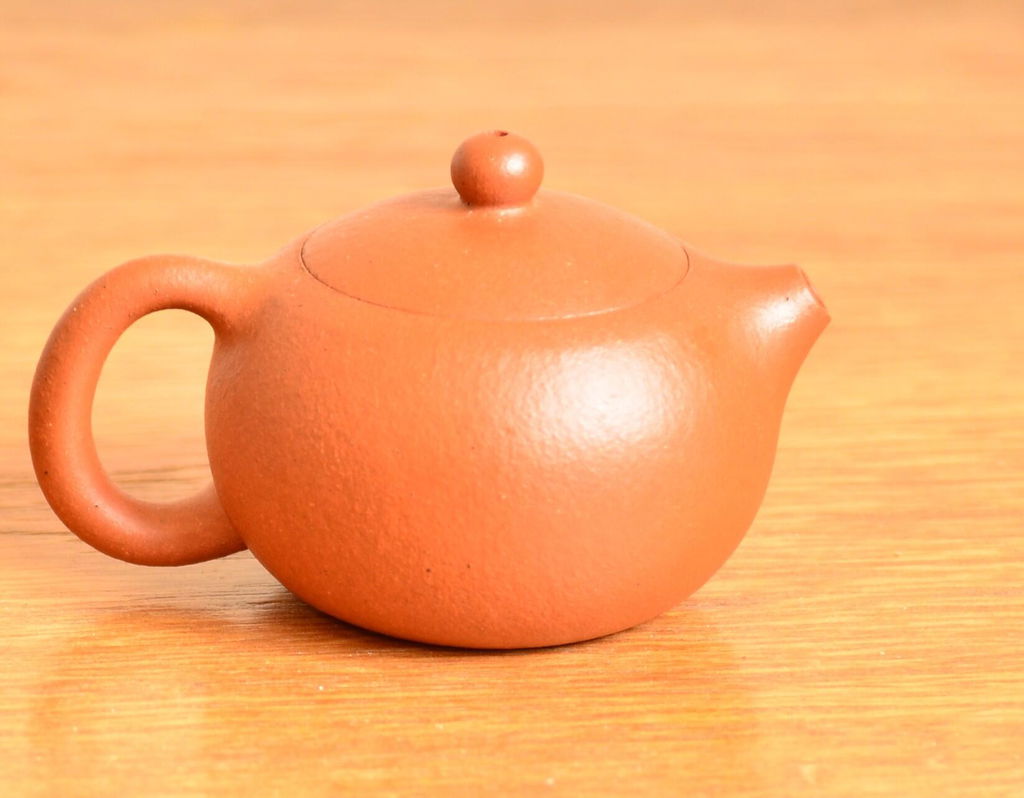
《平心壶》"Ping Xin ~ At Ease", 158.3ml, *Xiao Hong Ni 小红泥, by Craftsman Yang Pin Ting 杨聘婷, Engraving of Bamboos & Poem in Kai Shu 楷书 Calligraphy Style, by Craftsman Yi Cheng 逸成!~!🧧Congratulations to Mr J.K.🧧! 1341hrs 25th Feb 2026, Lexington! MA!
《平心壶》"Ping Xin ~ At Ease"


Senior Master Cao Lan Fang and our QC Chief Craftsman Yi Xiao Ran have managed to bring Craftsman Yang Pin TIng to join us! Born 1996, and started learning the Craft of Fully-Handmaking ZiSha Art at twelve years of age. It was until 21 years of age that she started crafting Fully-Handmaking ZiSha teapots as her profession, after graduation at Wuxi University, and fighting as a livelihood doing purely Fully-Handmade ZiSha work. All by herself alone, and being heavily disillusioned for the past decade due to the worrisome status of Fully-Handmade ZiSha Art and Craft being tainted by falsity, duplicity and chicanery. She has been having a tough time in the past decade, despite her churning out intricate and elegant pieces in her own curated portfolio of works! AND NOW, WE ARE SO HAPPY for her, and for her love of the Art to continue strongly with our team work. Now, she joyously continue her path of dedication to serve all of you dearest Friends, the dearest Friends who are the guardians of the other half of our beloved journey of tea: Fully-Handmade ZiSha Art.
She now crafts alongside Craftsman Zhang Huan, Zhu Shu and Yi Xiao Ran in our small studios besides the River Li 蠡河 Shu Shan 蜀山!
Here Senior Master Cao Lan Fang entrusted Craftsman Yang with our Cao Family's batch of more sandy Xiao Hong Ni in order to deliver this minimal Ornate Ping Xin work to imbue it with a slightly rustic feel.
Hong Ni is Red Clay, and it has two big umbrellas: Zi Sha Hong Ni, and Zhu Ni! Xiao Hong Ni is one of the two types of ZiSha Hong Ni! ZiSha Hong Ni is inherently more sandy than Zhu Ni, with a delightful light-orange-cinnabar colour that we all love, and extremely trusty with its brewing excellently Aged Sheng Pu Er, and Shu Pu Er.
Generally, we favour Xiao Hong Ni 小红泥, Da Hong Ni 大红泥(Yuan Kuang Da Hong Pao 原矿大红袍), Zhu Sha 朱砂 and Hong Jiang Po Ni 红降坡泥 for these applications.


《平心壶》"Ping Xin ~ At Ease"
This lovely Ping Xin composition arisen under the artistic direction by Senior Master Cao Lan Fang!with Craftsman Yang Pin Ting's deft craftsmanship working wonders!
A shape that Cao Lan Fang had designed the organic lid knob with the very lovable likeness of naturally swivelled stalk of a Tian Gua, and Craftsman Yang delivers beautifully! A beautiful miniature sculptural work of Art born of her keen eye and detailed craftsmanship! As it cleverly tapers and swivels upwards, the Tea Master user will find it ergonomic to hold it up with grace and grip! At the lower broader end, Craftsman Yang completes this delightful motif with an L-shaped ventilation port:


Craftsman Yang aces the gorgeous Qian Gai interface! Narrow gap allowance makes for a satisfying and soothing work of Art in operation!


with a strong and straight bamboo embellished spout,

And balancing at the back with the same signature bamboo segmented design.


She also crafted the BROAD NA DI BASE!


"地势坤;君子以厚德载物。"
摘自《易传·象传上·坤》
Excerpt from the Commentary on the Image of the Book of Changes, Part 1, Kun (坤)
"A virtuous person should treat all people and things in the world with kindness and generosity, and treat others with virtue, thus embodying the principle of "rule by virtue".
Bring this home early for more brilliant tea tastings with your guests, as you and your guests appreciate the visual beauty of the Bamboos engraving and reflect upon the verse engraved in Kai Shu 楷书 Calligraphy Style by Craftsman Yi Cheng 逸成!


Bamboos embrace the other facade.


Shrinkage of Fully-Handmade ZiSha craft:


Craftsman Yang wishes all of you a happy New Year of the Horse!and hopes this absolutely freshly fired work brings delight and beauty to your tea table!


ZiSha Art is the most amazing carrier medium, here Craftsman Yang's work housing Five aspects of Chinese Cultural Arts!
1. Fully-Handmade ZiSha Art and Craft,
2. Painting,
3. Calligraphy,
4. Poetry,
5. Engraving Art and Craft.
Hold, Use and Keep relishing all five aspects of our Chinese Culture in your daily life, in solitude, in practice, during hospitality to family and friends alike!
Savour the journey, dearest Friends :-D
~~~~~~~~~~~~
Hold one, hold up one, swing her work around. Carefully examine her Fully-Handmade work. Look at it from afar, from near, and it will grow on you. The whole piece grow on you because 1) she takes reference from what the Senior Masters chose for her, 2) and she amazingly crafts them up EXACTLY as to what the Senior Masters want from him: extreme fine detailing with MUCH THOUGHT on each part, with MUCH TIME spent on every part, section. Because this is what Fully-Handmade ZiSha Art should be, and HOW FULLY-HANDMADE ZISHA ART is so different from and light years ahead of the ubiquitous jigger-machined pots and half-handmade pots masquerading under the sales tagline of "fully-handmade zisha" pots. These latter JM/HHM pots are made in what we call 流水线 a.k.a. 'Factory-Line operation' whereby the main pot body after being jigger-machined or coming off from the mould, is passed to the next worker who fits on the spout, and subsequently this second worker will pass the pot on to another worker who will in turn fit on the handle. Continuing so, the pressed lid is likewise passed to another worker who fit on the lid knob. EACH WORKER has NO IDEA what the other one is doing, and they are always working on fixed time lines stated by the boss. For example, the worker being "passed the baton" a pot with the spout just fixed onto the body by his colleague, will only focus on fixing on the handle, with nil to little regard to WHETHER THE HANDLE fixed on will be cohesive with the spout. Each worker has NO idea of HOW THE FINAL POT WILL LOOK LIKE. Beyond poor craftsmanship and clay, the result of such processes are ugly pots with poor cohesiveness which experienced Artists, Craftsmen and collectors will tell from a metre away. Experienced people in us, do not need to pick up a pot to check whether it is fully-handmade or made of zisha, we can tell from a metre away just by looking at the pot.
~~~~~~~~~~~~
The keywords are: Detailing and Cohesiveness.
A GOOD Fully-Handmade ZiSha Work combines great detailing and cohesiveness.
~~~
Explained, https://www.realzisha.com/blogs/news/actual-zisha-landscape-at-yixing , the Craftsman by selling his hard-worked ZiSha craft at $190-$240, $45-$65 goes to the cost of the craft, inclusive of the fees for the firing for the kiln operator (three times per pot), the packaging boxes, and between $32 to $52 for the clay (Zi Ni Di Cao Qing, Duan Ni and upwards) used per pot. Craftsman takes 3 days (fastest 2.5days) to craft a pot.
If he works 30 days a month without a single day of rest (no family time), he will craft 10-12 pots.
If he crafts for 25 days (five days of rest a month), his output will be 8-10 pots.
The success rate for Zi Ni (e.g. Di Cao Qing, Lao Zi Ni, Da Shui Tan etc) and Duan Ni (e.g. Jiang Po Ni, Qing Hui Duan, etc) is 70% on average. Some times the whole batch of 10 may fail. We have seen our Craftsmen suffer like this very often.
The success rate for Zhu Ni (e.g. Xiao Mei Yao Zhu Ni) pots is 60%, or 70% with most optimism and at the very, very best. Unfortunately.
All of us at RealZiSha of course, hope for one another, professional colleagues and all, that all the pots will survive firing at the kiln successfully.
[For ZiSha models/designs that are very challenging and more complicated to craft, the time taken to craft will be longer, and the failure rate will be higher as well. Zi Sha by its virtue, have the highest shrinkage rate of all ceramic clay. Zi Ni and Duan Ni thus have that 70% success rate, while Zhu Ni has even higher shrinkage rate and thus even lower success rate (the lowest of all ceramic clay.)]
Our Craftsmen are wholeheartedly committed to the cause of Fully-Handmade ZiSha Art and their strictness with their craft and dedication earn our respect. We give a big Thank You all of these Craftsmen, for they are saving what is our common precious tea culture: Tea + Fully-Handmade ZiSha Art and Craft. Your support is critical to their livelihood and the existence of this craft for all of the tea fraternity.
Thank you Friends!
~~~~~~~~~~~~~~~~~~~~~~
Also to be cherished and witnessed in this ZiSha Work, you : besides the usual important, critical and beautiful hallmarks of a Fully-Handmade ZiSha pot, this pot has the discontinuous and roughly horizontal marks evident on the inner walls, and these are called the: 泥凳纹 Ni Deng Wen, which are the marks left on the clay slab, complementary to the marks on the workbench of the Craftsman Zhu Shu; During the making of FHM ZiSha pots, the Craftsmen will be using tools to cut the clay slabs, etc, and these cutting strokes will leave marks on the studio workbench. Especially the first major forceful cut across the table to delineate the clay she/he wants to utilize to form the main body of the body. Thus when the craftsman subsequently pound the clay slab on the workbench, these marks will be etched onto the clay slab. Thus you are "enjoying" the additional natural hallmarks of a Fully-Handmade pot. Even a partially handmade pot will not show these marks. And those fake, those Jigger-machined pots may show CONCENTRIC continuous circular lines, usually all parallel to one another, and extremely uniform.
~~~~~~~~~~~~